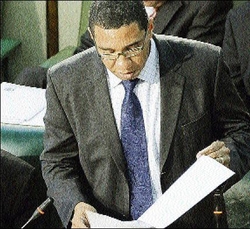
Education Minister Andrew Holness, seen here in Parliament Tuesday, said the multimillion-dollar government initiative is geared towards ensuring that children were enlisted in age-appropriate learning programmes.
GOVERNMENT IS to spend $82 million on approximately 2,000 students next year under a Career Advancement Programme (CAP) ,aimed at certifying and training unattached youths.
Education Minister Andrew Holness, who gave details of the programme in Parliament Tuesday, said it was seeking to ensure that children aged three to 18 are attached to, or attending structured learning programmes appropriate to their age and development.
"The ministry's policy is to cut off failure and not to prepare for failure through remediation. This is not a remedial programme," Holness told Parliament Tuesday.
He added: "Our attention is to design a programme to accommodate them (students performing below their grade level) but it is also our intention to cut off the flow of students who are illiterate and operating below their age-appropriate level."
Thwaites urges delay
While many opposition members welcomed the new prog-ramme, at least one member of parliament has urged that Holness delay the January implementation.
Ronald Thwaites, the central Kingston MP, said the policyshould be subject to the widest stakeholder consultation.
"This can't be a creature just of the Ministry of Education, however erudite they are. It requires a full discourse which is appropriately done in the committee of Parliament," Thwaites said.
But Holness disagreed. He said the Parliament had fully discussed the issue over many years.
"Now is not the time for more talk. Now is the time for action. If it satisfies the member, I will agree for it to go for further talk, but the ministry's programme will continue," Holness said.
Under the new programme, with the school-leaving age being pushed up to 18, students would either have to go to sixth form or to tertiary institutions.
In the cases where they do not matriculate to those levels, Holness has proposed two additional years as the fix to get them ready for the world of work.
"They can get into a programme where they can continue their academic development, but they are given an opportunity to advance in the vocation- and application-based fields," Holness said of students who have limited certification at the end of grade 11.
The education minister said those students have no qualifications and are "normally just left out in the labour market, left in limbo, unable to access any form of further education or training".
Heart to help
The HEART Trust and the Jamaica Foundation for Lifelong Foundation will assist in numeracy and literacy training.
Ministry of Education statistics indicate that of more than 51,600 students of grade 11 age in 2008, only 40,690 were in school. The ministry data showed that more than 10,000 of the cohort dropped out as far back as grade nine, more than 9,000 did not sit examinations, and an additional 6,000 students fail all subjects taken at the Caribbean Secondary Exam-ination Certificate (CSEC) level.
Eleven schools in various sections of the island have been selected for the start-up of the programme. The schools are Herbert Morrison Technical, Kemps Hill, Haile Selassie, Morant Bay, Penwood, St Anne's, St Vincent Strambi, Edith Dalton James, Charlemont, Dinthill and Bog Walk.
Holness accepted a suggestion from North Trelawny MP, Dr Patrick Harris, that Government should consider a stipend as a means to encouraging participants to remain in the programme.
daraine.luton@gleanerjm.com

MP Ronnie Thwaites on Tuesday urged that there be more dialogue on the programme before implementation. - photos by Rudolph Brown
Programmes being offered
Art and craft
Carpentry/customer service
Electrical installation
Cookery
Musical performance
Hair styling
Data operations
Masonry
Nail technology
Welding
Marketing and promotions
Business administration
Customer service
General office administration