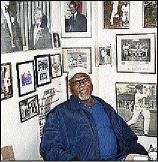
Michael Chambers - Photos by Gordon Williams
HARTFORD, Connecticut, United States:
In one corner of the modest second floor walk-up, a dramatic photograph of young Michael Holding angrily kicking over stumps during a Test match in New Zealand grabs a visitor's attention.
"I'm not sure it's something Mikey is too proud of today," chuckles Michael Chambers, director of the Cricket Hall of Fame (CHF) here, as he points to that memorable snapshot and others, plus articles of the former great Jamaica and West Indies fast bowler in what he calls 'Holding's Corner'.
But there is much more that Holding and cricket lovers from the West Indies and elsewhere can gladly embrace at the CHF, which founders call the "first in the world".
Located above a Caribbean restaurant on Main Street in this northeast American city, it serves up a delicious sampling of cricket history.
A huge photo shows Windies legends Sir Garfield Sobers and George Headley in conversation. Another captures Sir Vivian Richards attacking the bowling, right next to Headley in similar mood. There's Worrell. Weekes. Walcott. Brian Lara raising his bat. Collie Smith on the go. Big-smiling Desmond Haynes. Lance Gibbs about to deliver.
memorabilia
Around the cluster of rooms, which occupy some 1,000 square feet, memorabilia drag minds back to when cricket was king and the West Indies produced some of the game's best. In a framed box is the first piece donated to the CHF, Jamaican Alfred Valentine's folded West Indies sweater with shirt tucked inside.
Autographed photos, bats and gloves, statues, a West Indies blazer from a tour of India decades ago, newspaper and magazine clippings, books, photographs and trophies, all offer an informative peek into the game's great past and particularly the West Indies' contribution to it.
A photo of Jamaican track star Usain Bolt's September 28 visit offers a reminder why it's a place cricket enthusiasts should see. The reason for the CHF is simple.
"We need to start hero worshipping our athletes who have excelled and let them feel like they're wanted," said Chambers.
For that reason, Sportsmen's Athletic Club (SAC), a well-known organisation here, created the CHF nearly three decades ago. The original idea, championed by Jamaican-born Ken Wallace, was to create a "museum with a vision that cricket would become popular once again in the US", explains Chambers.
When Trinidadian Errol Housain joined SAC the focus took another step.
"He had the idea for the Hall of Fame," says Chambers.
The CHF was launched in 1980. The following year spinners Gibbs and Valentine became its first inductees in the international category, which includes mostly players who excelled on the world stage.
The CHF also has local inductees who have made significant contributions to the game in the United States and Canada.
Some 60 per cent of all CHF international inductees are from the West Indies.
"We justify it by saying that the era those guys played in, they were considered champions or number one performers at that time," Chambers explains.
But inductions are not restricted to them. Australian Greg Chappell, Indians Sunil Gavaskar and Gundappa Viswanath, and Pakistani Mushtaq Mohammed are among those included. Jamaican cricket writer Tony Becca and the late Australian businessman Kerry Packer are two international inductees who didn't play at the highest level.
The CHF has managed to induct 30 internationals and 45 locals, despite being dormant for some five years in the 1990s due to lack of funds.
Today, its modest appearance, Chambers stresses, does not detract from the CHF's importance. Former greats, he says, are grateful their accomplishments are being recognised. All but two of the inducted players journeyed here for the ceremony.
Previous commitments prevented Chappell from coming, but a video hook-up allowed him to address the function live.
Former West Indies batsman Alvin Kallicharran visited the CHF to accept a humanitarian award a few months before his own induction and was unable to make a second trip that year for the ceremony.
Years after the CHF here was started, other similar institutions have sprouted elsewhere, including in the Caribbean, England and Australia. But the CHF claims credit for first developing an idea it believes was way overdue.
"When we met Valentine and Gibbs at the first induction ceremony, when they expressed their appreciation that nothing like this had happened to them, you know you had to do it," he says.
The CHF is convinced it's worth it.
"When we did Holding's induction we showed him the 1976 footage of him playing against England. We know that changed his life, changed him forever," Chambers adds.
"Gavaskar took sick, he was so nervous when he came. (Windies pacer) Joel Garner cried like a baby when he talked about his relationship with cricket at his induction. It was a moving occasion."
The induction ceremonies also thrill CHF supporters. They meet their heroes and share experiences. The CHF believes cricket's former greats have value waiting to be harnessed.
"Valentine, when he was inducted, he was in Florida as an ordinary citizen," says Chambers. "But if you could have carried your country to such a height in the sport of cricket, he should have been recognised and be working in the game, not living a mediocre life."
Yet, the CHF is not yet an open book - literally. Visitors must notify the CHF prior to showing up, so someone from the committee can give them access.
Part of the reason is to reduce expenses, says Chambers. While the city assists by, for example, giving a proclamation declaring a day for inductees and have them meet the mayor or occasionally the state's governor, the money to keep the CHF comes directly from the SAC committee members. Chambers claims it costs as much as US$2,000 a year each.
expansion
Still, the aim is to expand the CHF, get its own building. That will also mean acquiring additional memorabilia, especially from players. That could be a problem.
"Holding said the last match he played he threw away his boots," explains Chambers. "He didn't keep anything. Most of the players don't really have anything. They left the game disillusioned."
The CHF admits it has not yet started to reach out to current players for memorabilia.
"We're not at that point yet," Chambers says.
Present-day stars, he also confesses, may be unaware of the CHF. Chambers hopes the legends will pass on the word.
Former greats, like India's Farokh Engineer, who was inducted on October 3, was quoted as saying he was "impressed" with the CHF and had "yet to come across any collection like this" in the world. It's the CHF's final applause.
"What we do is that we give the players one last hurrah," says Chambers.
"They came to the end of their playing career and they can now carry their induction honour into the Hall of Fame to their graves."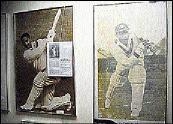
Sir Frank Worrell (left) and Collie Smith
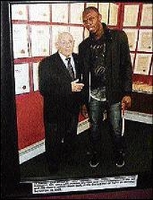
Usain Bolt (right) on his visit to the Hall of Fame.
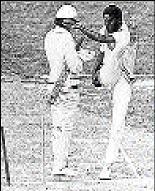
Holding kicks out stumps