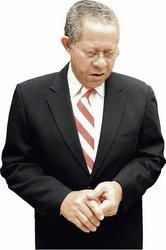
Golding
Prime Minister Bruce Golding has challenged the Opposition to a public debate to seek solutions for a country steeped in crisis and labelled by The Economist news magazine as "unfixable".
Golding declared Sunday night, during a Jamaica Labour Party (JLP) Area One Council meeting at the Denham Town Community Centre in his West Kingston constituency, that his government now has the task of not only surviving the storm of global recession, but correcting the missteps of the last People's National Party (PNP) government.
No growth for Jamaica
"How come, after 18 and a half years, when the world was growing, Jamaica could not grow?" he asked the crowd of JLP supporters as he lashed the former administration.
While the prime minister ponders the seemingly insurmountable challenges his administration faces, The Economist, a weekly United Kingdom-based news magazine focusing on international politics and business news, is painting a "gloomy picture of Jamaica", suggesting that the country's burden of debt and crime are "unfixable".
"Just over two years ago, when Bruce Golding's Labour Party came to power in Jamaica, ending 18 years in opposition, there were modest hopes that it might make progress in tackling the island's endemic problems of economic stagnation and gang violence," read a recent article in the magazine.
"Quite how hard that is has become clear in the past fortnight with the departure first of the central-bank governor and then the police chief."
The article, published in the November 12 edition of the magazine, made reference to the huge debt the JLP inherited and the country's high debt-servicing bill.
Some 60 per cent of government's revenue goes towards servicing debt.
Outlining an even darker future, The Economist reported that "the world recession has hit tourism, bauxite and remittances from Jamaicans abroad, the island's three big foreign-exchange earners; UC Rusal, the country's biggest bauxite operator, has shut most of its Jamaican mines because of low world prices".
It continued: "With tax revenue down and privatisation plans stalled, the fiscal deficit has soared."
During his address Sunday night, Golding said the two years he has spent in power were harder than any of the 18 and a half spent by the PNP as that party never had to contend with a recession.
Yesterday, opposition spokesman on industry Mark Golding said he would be in support of a debate if it would lead to a solution on nation building.
"A debate should be a way forward and how we approach and arrive at a consensus to pull the country out. I don't like a debate about the past," the PNP treasurer said.
Mark Golding also said the JLP had been disingenuous about the achievements of the PNP and had not fully accepted its role as government.
"What the JLP has failed to recognise is that we achieved a great deal. We inherited an indebted economy, but we stabilised the macroeconomic parameters going into the last five years of our term in office," he said.
"In the JLP's two years, we have seen a rapid increase in the build-up of national debt by about 30 per cent. We have seen negative growth. We have had a significant and dangerous reduction in our credit rating, and we are paying a high no-confidence premium in our domestic interest rate."
Political analyst Martin Henry said such a debate, in the middle of an electoral cycle, would bear little fruit.
"Furthermore, the Parliament is the constitutional locus for discussing national issues, not an avenue for extra-parliamentary discussion by political parties to arrive at any consensus."
Milton Samuda, president of the Jamaica Chamber of Commerce, also said a debate between the two parties would not serve a useful purpose.
"We are great on talk and short on action, and what we need now is for the governing party to make decisions, and you (Golding) convince the people of Jamaica to go with them, whichever direction they go," he told The Gleaner.
( L - R ) Mark Golding Samuda