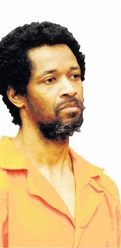
Muhammad
WHEATON, Maryland (AP)
When James D. Martin was shot dead on an early October evening seven years ago in the parking lot of a grocery store in Wheaton, a northern Washington suburb, it got little attention on the nightly news.
Early the next morning, a landscaper was fatally shot in nearby Rockville, also by a .223-calibre bullet. Then a cabbie, at a gas station not far away. There was another shooting a half-hour later just up the road, a woman slain as she sat reading on a sidewalk bench. Within 90 minutes, another woman was gunned down while vacuuming her van at a service station.
By 10 a.m., it was clear that something sinister was happening. Something awful.
Then it spread.
A sniper killing that night in Washington moved the killings south. The next day, a woman was wounded in a craft store parking lot in Fredericksburg, Virginia, 80 kilometres from Washington, DC.
Fear reigned. People stayed indoors, afraid to go shopping or pump gas. Authorities on television recommended ways to avoid becoming targets. Schoolchildren were kept inside at recess and drilled on duck-and-cover techniques.
Then came a lull, three days without a shooting. But on October 7, 13-year-old Iran Brown was shot in the chest as he was dropped off at school in Bowie, Maryland, just east of Washington.
"Shooting a kid, it's getting to be really, really personal now," a tearful Montgomery County Police Chief, Charles Moose, told a news conference as the nation's collective concerns settled on its capital.
There were three more fatal sniper shootings in Virginia the next week, followed by another break - three days. Four. Five. Just long enough for people to relax, at least a little.
"We were thinking everything was going to be OK," said retired school teacher Bernice Easter, of Wheaton.
It wasn't. On October 19, a man was shot outside a steakhouse in Ashland, Virginia, about 130 kilometres south of Washington. Three more days passed quietly. Then bus driver Conrad Johnson was killed in Aspen Hill, Maryland, not far from where the shootings began.
Nerve-tingling terror
On October 24, police captured John Allen Muhammad and teenage accomplice Lee Boyd Malvo at a rest stop 80 kilometres northwest of DC. Muhammad and Malvo had shot people at random with a high-powered rifle, firing from the trunk of a modified, beat-up Chevy Caprice. Ten were killed before authorities finally tracked down the pair at a Maryland rest stop.
The nerve-tingling terror that had gripped the region's 5.4 million people and captivated the nation was over.
As Virginia prepares to execute Muhammad tonight, at 9 p.m., for murdering Dean Harold Meyers at a gas station in Manassas, echoes of those three weeks on edge are reverberating throughout the region. (Malvo, who was 17 at the time of the shootings, was convicted and sentenced to life in prison.)
"I don't think anybody felt safe," said Easter, now 82. "I was afraid to go out in my yard."
Paula Jean Hallberg, 54, of Silver Spring, felt a shiver every time she walked across the YMCA's wide-open parking lot.
"I would move about a lot," she said.
Ginger Pinchot, 67, a learning specialist from Kemp Mill, would start the gas pump and then sit inside her car.
"It was just that random feeling," she said. "It feels like a roulette wheel when you don't know where it's going to hit next."
Steve Murchake, 59, a tax accountant from Silver Spring, Maryland, remembered helicopters roaring overhead seemingly every morning as he started his commute to Herndon, Virginia, and the checkpoints that snarled Beltway traffic after nearly every shooting. Police focused on white utility vans and white box trucks, which witnesses had spotted, coincidentally, it turned out, near some of the shootings.
House painter José Romero, 39, of Silver Spring, parked his white van and took his car to work to avoid being stopped by police. Like everyone else, he imagined cross hairs trained on him whenever he stopped for gas.
"Keep moving around, don't be a target, that's what I heard on the news," Romero said.
Christian Torrenegra said he and his friends at Newport Mill Middle School in Kensington quit walking to a nearby mall after school and took the bus straight home instead. Safe on board, they made a game of pretending to spot the sniper.
"It was like, 'Oh, I see the van!"' said Torrenegra, now 19 and a student at Montgomery College. "We didn't want to take it seriously because we were so young, but at the same time we were scared."
Rachel Pinchot, Ginger's daughter-in-law, said she has not been able to bring herself to go back to the Aspen Hill grocery store where James Martin was killed.
Such lasting effects are not surprising, said N. Kyle Smith, associate professor of psychology at Ohio Wesleyan University. Negative news tends to influence one's behaviour more strongly than positive information, he said, and the contagion of group anxiety can intensify one's emotional response.
"Even though the fear is gone, the effect on their behaviour can still linger," Smith said.
Montgomery County's Mental Health Association received hundreds of calls from apparent first-timers during the sniper period, executive director Sharon E. Friedman said. Many were parents seeking advice on dealing with both their children's fears and their own.
Calm at last
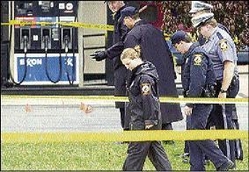
In this October 2002 photo, Henrico County police investigators search the grounds at a gas station in suburban Richmond, Virginia. John Allen Muhammad is scheduled to die by injection at a Virginia prison today for the slaying of Dean Harold Meyers at a gas station during a three-week spree in 2002 across Maryland, Virginia and Washington, DC. - FILE
"We advised people to try to stick to their routine as much as possible," even if it meant exercising at home instead of the gym, she said. "The routine is a comforting thing."
At Brookside Gardens, a botanical park in Wheaton, a granite monument to the region's 10 slain sniper victims invites quiet reflection on a time that was anything but tranquil. Spokeswoman Leslie McDermott said she hopes Muhammad's execution will bring calm at last.
"I think everybody was victimised," McDermott said. "I think everybody lost a sense of freedom and innocence during that time. They were scared."
Yesterday the US Supreme Court refused to block the scheduled execution. Muhammad still has a clemency petition before Virginia Governor Timothy M. Kaine.