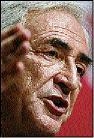
Strauss-Kahn
Dominique Strauss-Kahn, managing director of the International Monetary Fund (IMF), has accepted that policies pursued by the lending agency have hurt developing countries.
He said, however, that the IMF has learnt from mistakes of the past and that the institution is more responsive today.
"It's no secret that our lending programmes attracted some criticism over the years. People said our conditions were too harsh, too intrusive, or even misguided. I accept some of that criticism. We made mistakes, but we always try to learn from our mistakes," said Strauss-Kahn, French finance and economy minister.
Heavy-handed policies
He told a Resources for the Future conference in Washington, DC, yesterday that the days of heavy-handed IMF policies were over, as the agency had reviewed the usual lending conditionalities it imposes.
"... We need to make sure that the medicine does not harm the patient. Over the past few years, we have been streamlining our conditionalities, focusing on core policy measures that are critical for macroeconomics stability, poverty reduction and growth," Strauss-Kahn said.
He added: "Too many conditions in too many different areas can reduce effectiveness and lead to a loss of legitimacy."
Political and labour interests in countries like Jamaica have protested the posture of the IMF towards its debtors.
At present, the country is in the process of preparing a letter of intent to re-enter a borrowing relation with the multilateral agency. Jamaica is seeking to borrow US$1.2 billion under a standby loan programme.
Channels
Meanwhile, Strauss-Kahn yesterday said the "crisis is striking through many different channels, all pointing to its global and all-encompassing nature".
He said that exports from low-income countries could drop this year by 16 per cent and that remittances may fall this year by up to 10 per cent. He has also predicted that foreign direct investment to low-income countries may fall by 25 per cent this year.
He urged developed countries not to leave the weaker ones behind and warned against any form of protectionist policies, saying he expected the world economy to recover in 2010.
"But we cannot take things for granted. The pace of global recovery is far from assured, and the poorer countries may suffer after-effects for years to come," he said.